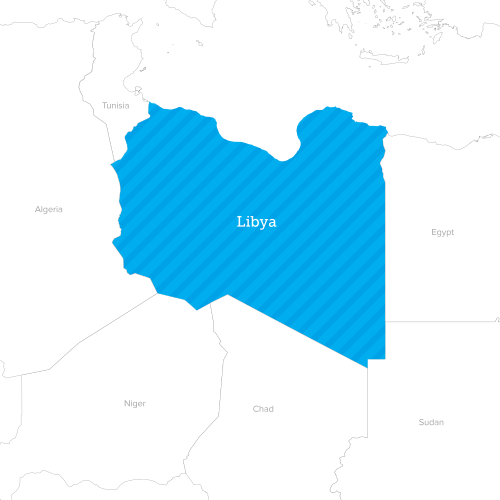
Libya
Shortly after Libya’s civil war began in 2011, International Medical Corps deployed teams to provide countrywide emergency medical services, train health workers and deliver vital medicines and supplies. Starting in the country’s east, we built makeshift health facilities to provide critical care to conflict-affected populations and moved with the front lines westward until the fighting dissipated.
As the situation progressed, we transitioned from emergency activities to programmes that fostered recovery and self-reliance, targeting vulnerable populations deprived of access to basic healthcare—including internally displaced people, refugees and the growing number of migrants transiting through the country on their way to Europe. International Medical Corps supported the physical rehabilitation of health clinics, and we continue to provide medical aid to those in urgent need of care while providing a broader range of services that benefit the wider Libyan and non-Libyan populations.
7.5 million
71/75 years
male/female
28.8 years
The Challenges
Fractured Health System
Libya has about 1,300 health facilities for a population of 7.5 million.

Natural Disasters
Storm Daniel struck northeast Libya in September 2023, leading to catastrophic flooding and significant damage.
Displaced people
There are nearly 858,000 refugees, asylum seekers, IDPs and returnees in Libya.
Our Response

Healthcare
International Medical Corps operates mobile medical teams (MMTs) that provide vital healthcare services to Libyans and non-Libyans. Our MMTs are supported by community health workers who are critical in raising awareness among migrant and refugee communities about common health problems.
The MMTs also organise regular training and on-the-job tutorial sessions for healthcare providers, ensuring the availability and continuity of essential services, particularly in underserved and hard-to-reach areas. International Medical Corps is committed to strengthening the national healthcare system through our long-term partnership with Libya’s Ministry of Health (MoH). This includes building the capacity of healthcare workers, supporting health facilities with essential equipment and supplies, and strengthening service delivery in underserved areas.
As part of our response in Al Kufra, International Medical Corps provides essential healthcare services through MMTs deployed in public health facilities and in informal settlements. We also conduct comprehensive training for national nurses, focusing on clinical skills and service delivery in emergency settings. We support maternal and newborn health through antenatal and postnatal care, health education, and the facilitation of referrals for safe delivery services and specialised care when needed. Our teams also support the early identification, referral and follow-up of priority communicable diseases, including tuberculosis, helping to strengthen disease surveillance and continuity of care. And we provide essential medical equipment to public hospitals to strengthen their ability to deliver and sustain basic health services for the refugees and residents of the host community. International Medical Corps co-leads the health task force under the Sudan regional refugee response plan (RRP) in Libya.
Additionally, International Medical Corps previously implemented programmes to prevent and respond to violence against women and girls in Libya through awareness sessions, case management, psychosocial support and skill-building activities. We have collaborated with local authorities, service providers and partner organisations to strengthen service delivery and improve access to care. We have worked with three national organisations to adapt services in health facilities and schools, provide psychosocial support, and gather community feedback to ensure a responsive, context-sensitive flood response.

Mental Health and Psychosocial Support
International Medical Corps provides mental health and psychosocial support (MHPSS) services through trained doctors who identify, manage and refer priority mental health conditions in line with guidelines from the World Health Organization. We also build the capacity of healthcare providers at the primary healthcare level on mental health topics, ensuring that they can provide MHPSS services as part of primary healthcare. To strengthen community-based MHPSS efforts, we train community focal people from different municipalities to facilitate training and awareness sessions that advocate for mental health at the community level. We have integrated MHPSS services into our response in Kufra as part of the country’s RRP, deploying MHPSS counsellors to deliver essential mental health support to vulnerable populations residing in informal settlements and at supported health facilities.

Water, Sanitation and Hygiene (WASH) and Non-food Items (NFI)
Following our emergency water, sanitation and hygiene (WASH)-related response in Derna and other flood-affected areas, we shifted our focus to sustainable, capacity-building solutions to support long-term recovery. We strengthened local authorities by providing water treatment chemicals to the General Company for Water and Wastewater. Our team also supplied essential equipment and tools for municipal water system repairs and installed solar-powered water desalination units with storage tanks in the most affected neighbourhoods. These interventions have helped to ensure a consistent and reliable supply of safe drinking water for those communities.
International Medical Corps is implementing a WASH programme in Al Kufra to prevent the spread of communicable diseases among Sudanese refugees and host communities. The programme focuses on community-based hygiene promotion, the distribution of essential hygiene supplies to Sudanese refugee households, and targeted support to improve WASH infrastructure and infection prevention measures in nearby health facilities.
We Were There: Storm Daniel
On September 10, 2023, Storm Daniel struck northeast Libya, causing two dams above Derna to collapse after months’ worth of rain fell within hours. According to the UN, 900,000 were affected by the floods. International Medical Corps deployed mobile teams to address health, WASH, MHPSS and other urgent needs. We delivered primary and emergency healthcare and trained national healthcare providers in affected areas. Learn more about our response to the flooding in Libya.
Our Impact in 2025
Delivering Critical Training to Libya’s First Responders
Working with local partners, our team provides emergency healthcare training to doctors, nurses and ambulance workers.
READ MORE


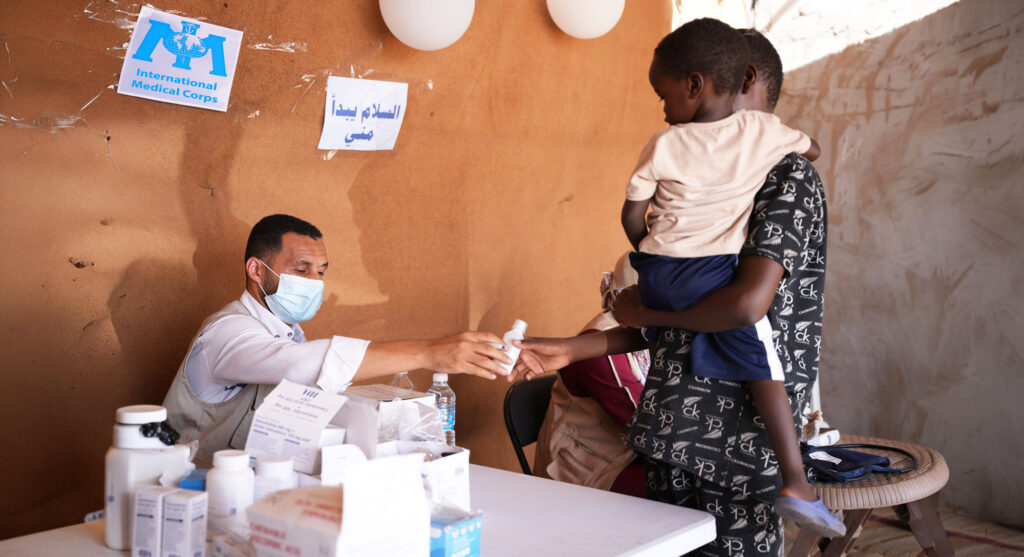
Our team provides Sudanese refugees in Kufra with lifesaving medications.
International Medical Corps trains physicians in Libya, focusing on cardiac arrest, life-threatening emergencies and resuscitation procedures.
Children celebrate World Mental Health Day with their friends and other families in the refugee camps.
An International Medical Corps mental health counselor provides phone services via the citizen service centre helpline in Tripoli.
An International Medical Corps physiotherapist helps a child learn to walk again after a car accident led to multiple surgeries on his knees.
Children participate in a well-being exercise as part of our psychosocial support programming for flood-affected families in Derna.